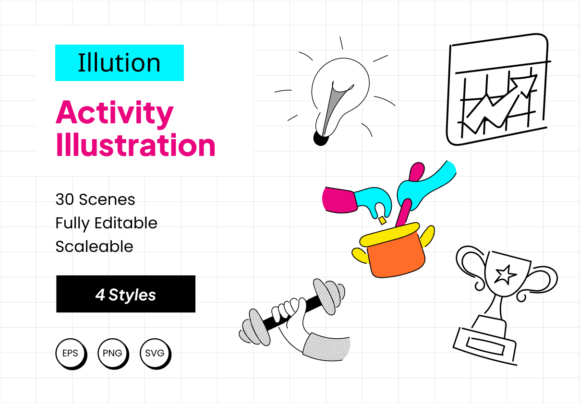
Transforming Digital Narratives with Illution - 30 Activity Illustration Assets
In the rapidly evolving landscape of digital communication, the ability to convey complex ideas through simple visuals has become a cornerstone of effective design. As businesses and creators strive to capture attention in crowded feeds and interfaces, the demand for high-quality, versatile imagery continues to rise. This is where resources like Illution - 30 Activity Illustration play a pivotal role. By offering a curated pack of 30x4 style elements, these assets provide a robust foundation for designers, developers, and marketers looking to enhance their projects without starting from scratch. The utility of such illustration packs extends far beyond mere decoration; they serve as functional tools that bridge the gap between abstract concepts and user understanding.
The Evolution of Flat Design and Modern Illustration Packs
Over the last decade, the aesthetic of the web and mobile applications has shifted dramatically. We moved away from skeuomorphism, which attempted to mimic real-world textures, toward flat design and material design principles that prioritize clarity and speed. Within this context, activity illustrations have emerged as a dominant visual language. These illustrations typically feature simplified human figures engaged in various tasks, often rendered with bold colors, clean lines, and a sense of motion. The Illution - 30 Activity Illustration collection aligns perfectly with this modern trajectory, offering a cohesive set of visuals that feel native to contemporary digital environments.
What distinguishes a professional-grade pack from generic clip art is consistency and scalability. A pack containing 30 distinct styles ensures that every element, whether it depicts a user coding, a team collaborating, or a customer shopping, shares the same DNA. This uniformity is critical when building a brand identity. When a website uses mismatched graphics, it creates cognitive dissonance for the visitor. Conversely, a unified visual system, such as the one provided by this specific illustration set, reinforces trust and professionalism. The inclusion of multiple style variations within the pack allows for subtle shifts in tone while maintaining overall harmony, a nuance that is often overlooked in lower-quality asset libraries.
Understanding the Versatility of Style Elements
The core value proposition of the Illution - 30 Activity Illustration lies in its adaptability. The "30x4" configuration suggests not just thirty images, but thirty base concepts available in four different stylistic interpretations. This depth allows designers to tailor the visual output to specific project requirements. For instance, a fintech startup might prefer a more geometric, structured variation to convey stability and precision, while a creative agency might opt for a looser, hand-drawn style to emphasize innovation and flexibility. This flexibility eliminates the need to commission custom artwork for every single screen or marketing piece, significantly accelerating the production workflow.
Furthermore, these style elements are designed to be modular. In many modern design systems, illustrations are not static blocks but are composed of layers that can be manipulated. Designers can swap out background shapes, change color palettes to match brand guidelines, or even isolate specific characters to create new compositions. This modularity turns a static asset into a dynamic tool. When implementing these assets in a web application, for example, a developer can use CSS variables to dynamically adjust the colors of the illustration based on the user's theme preference (light or dark mode), ensuring the visual remains accessible and engaging regardless of the setting.
Strategic Applications Across Digital Platforms
The practical utility of activity illustrations is best understood by examining how they function across different mediums. From the moment a user lands on a website to the final printout of a corporate presentation, these visuals guide the narrative and reduce friction in the user experience. The Illution - 30 Activity Illustration pack is specifically engineered to support this wide range of applications, making it an essential resource for professionals working in diverse sectors.
- Web Applications and SaaS Dashboards: Empty states are a common challenge in software design. When a user logs into a new account with no data, a blank screen can feel broken or confusing. An activity illustration depicting a user waiting for data or a friendly character guiding them fills this void effectively. It reassures the user that the system is functioning correctly and provides a visual cue on what actions to take next.
- Mobile Application Onboarding: Mobile screens offer limited real estate. Long paragraphs of text explaining features are often ignored. Instead, a sequence of three or four illustrations from the pack can tell the story of the app's value proposition instantly. A graphic showing a person scanning a QR code or syncing devices communicates functionality faster than any manual could.
- Marketing Materials and Landing Pages: In the competitive world of digital marketing, the first few seconds determine whether a visitor stays or leaves. Hero sections on landing pages benefit immensely from large-scale, high-impact illustrations. Using the Illution - 30 Activity Illustration assets here can humanize a brand, making a technical product feel approachable and relatable to a broad audience.
- Social Media Engagement: Social platforms are inherently visual. Static text posts often struggle to gain traction compared to those accompanied by compelling graphics. These illustration packs allow social media managers to create consistent branding across Instagram, LinkedIn, and Twitter. Whether it's a quote card, a product announcement, or a behind-the-scenes look, the consistent style builds recognition over time.
Enhancing Communication in Print and Presentations
While digital applications dominate the conversation, the relevance of these assets does not end on the screen. The high resolution and vector-based nature of modern illustration packs make them equally suitable for print media. Brochures, business cards, and trade show banners all require imagery that stands out in physical form. The clean lines and vibrant colors typical of the Illution series translate well to print, ensuring that the message remains clear even when scaled up for a large banner or down for a small flyer.
Similarly, work presentations often suffer from being text-heavy and monotonous. Incorporating activity illustrations can break up dense slides and keep the audience engaged. Imagine a slide deck pitching a new remote-work strategy; instead of bullet points listing benefits, a series of illustrations showing people collaborating virtually, managing time zones, and celebrating milestones can evoke the desired emotional response. This visual storytelling technique leverages the brain's ability to process images 60,000 times faster than text, making the presenter's arguments more memorable and persuasive.
Optimizing Workflows for Creators and Businesses
For business owners and creative teams, time is often the most valuable currency. The decision to utilize a pre-made asset pack like Illution - 30 Activity Illustration is frequently driven by the need to streamline operations without sacrificing quality. Custom illustration is an investment that requires significant budget and lead time. While there is no substitute for bespoke art in certain high-end branding scenarios, the vast majority of digital products do not require unique art for every single icon or scene. They require consistency, speed, and reliability.
By integrating these 30 activity illustrations into a design system, teams can establish a library of approved assets that are ready for immediate deployment. This standardization reduces the back-and-forth between stakeholders and designers. Marketing teams can pull assets directly from the library for social campaigns, while product teams can implement them in the UI without needing to brief an illustrator for every minor update. This efficiency allows organizations to pivot quickly in response to market changes or user feedback.
Moreover, the cost-effectiveness of such packs cannot be overstated. For startups and small businesses operating on lean budgets, purchasing a comprehensive pack offers a return on investment that rivals hiring a full-time designer. The versatility of the 30x4 style elements means that a single purchase can cover the visual needs of a website, a mobile app, a pitch deck, and a year's worth of social media content. This consolidation of resources simplifies asset management and ensures that the brand maintains a professional appearance across all touchpoints.
Considerations for Implementation and Accessibility
While the benefits of using illustration packs are substantial, successful implementation requires thoughtful consideration of accessibility and inclusivity. Activity illustrations often depict human figures, and the way these figures are represented matters. Designers should ensure that the chosen style elements reflect diversity in terms of gender, ethnicity, and ability. Many modern packs, including those similar to Illution, have evolved to include a wider range of representations, allowing creators to build inclusive narratives that resonate with a global audience.
Additionally, color contrast is a critical factor, particularly for web and mobile applications. While the default colors in an illustration pack may be vibrant and appealing, they must meet WCAG (Web Content Accessibility Guidelines) standards when placed against various backgrounds. Fortunately, because these assets are often delivered in formats that allow for color manipulation, designers can easily adjust hues to ensure sufficient contrast ratios for users with visual impairments. This attention to detail demonstrates a commitment to usability and broadens the reach of the product.
Fostering Creativity Through Constraint
There is a paradoxical truth in design: constraints often foster greater creativity. Having access to an infinite array of options can sometimes lead to analysis paralysis, where designers spend more time choosing assets than creating solutions. The Illution - 30 Activity Illustration pack provides a defined set of parameters—a specific style, a fixed number of activities, and a coherent color palette. Within these boundaries, creators are challenged to find novel ways to communicate their message.
This limitation encourages problem-solving. Instead of searching for the "perfect" image that doesn't exist, designers learn to combine existing elements in unexpected ways. They might crop an illustration to focus on a specific action, layer two different scenes to create a composite narrative, or animate the elements to add a layer of interactivity. This approach not only speeds up the design process but also results in a more cohesive and intentional visual identity. The discipline required to work within a specific style guide ultimately leads to stronger, more polished outcomes.
As the digital ecosystem continues to expand, the demand for high-quality, adaptable visual content will only grow. Resources that balance aesthetic appeal with functional versatility will remain at the forefront of design trends. Whether you are a solo entrepreneur launching your first MVP, a marketing director overseeing a global campaign, or an educator creating interactive learning materials, the strategic use of activity illustrations can elevate your work. The Illution - 30 Activity Illustration pack represents more than just a collection of images; it is a toolkit for modern communication, empowering creators to tell their stories with clarity, impact, and style.